28 January 2015

107 Confirmandi to be presented


Archbishop Gustavo Garcia-Siller will be administering the Sacrament of Holy Confirmation at Our Lady of the Atonement Church next Wednesday, February 4th, at 6:30 in the evening, and he will be the principal celebrant of the Anglican Use Mass. It will be my privilege to present 107 confirmandi to him. Also, many of them will be receiving First Holy Communion at that Mass.

Defend, O Lord, thy servants with thy heavenly grace; that they may continue thine for ever; and daily increase in thy Holy Spirit more and more, until they come unto thy everlasting kingdom. Amen.

27 January 2015

St. Thomas Aquinas, Angelic Doctor


One of the greatest Catholic teachers in the history of the Church, St. Thomas Aquinas is honored with the titles Doctor of the Church and Angelic Doctor.

His parents had plans for him. In the year 1230, when he was only five years old, they took him to the Benedictine monastery at Monte Cassino, and it was their hope that he would choose to become a Benedictine there, and eventually become abbot. In 1239 he was sent to Naples to complete his studies. It was here that he was first attracted to philosophy of Aristotle, and he saw how that philosophy could be used in the service of Catholic theology.

Thomas abandoned his family's plans for him and he joined the Dominicans, much to his mother's dismay. In fact, she ordered one of her other sons to capture Thomas away from the Dominicans, and he was kept at home for over a year. Of course, that couldn’t last forever, and once he was free, he went to Paris and then to Cologne, where he finished his studies with St. Albert the Great. He eventually became a professor at the University of Paris, and was known throughout the Church as one of the great scholars of all time.

But along with him fame as a scholar, he remained modest, a perfect model of childlike simplicity and goodness. He was known for his mildness in speaking and for his great kindness. Whatever clothing or other items he could give away, he gladly did. He kept nothing superfluous in his efforts to alleviate the needs of others.

His great Summa – which was his last and, unfortunately, uncompleted work, is a compendium of the whole of Catholic theology. He stopped work on it after celebrating Mass on December 6, 1273. When asked why he stopped writing, he replied, "I cannot go on.... All that I have written seems to me like so much straw compared to what I have seen and what has been revealed to me." He died just a few months later.

Almighty God, who hast enriched thy Church with the singular learning and holiness of thy servant St. Thomas Aquinas: Enlighten us more and more, we pray thee, by the disciplined thinking and teaching of Christian scholars, and deepen our devotion by the example of saintly lives; through Jesus Christ our Lord, who liveth and reigneth with thee and the Holy Spirit, one God, for ever and ever. Amen.

26 January 2015

St. Angela Merici


St. Angela Merici was born in 1474 in Verona (in what is now Italy), and she founded the first teaching congregation of women in the Church, the community dedicated to St. Ursula, known as the Ursulines. As a young woman she became a member of the Third Order of St. Francis, and lived a very simple life – in fact, a life that was so austere, that she wanted to live like St. Francis of Assisi. She wanted to own nothing of her own, so that she wouldn’t become attached to anything. Early in her life she was very concerned about the ignorance about the Faith among poorer children, whose parents could not or would not teach them even their basic catechism. She set out to provide simple lessons for those children who needed to be formed in their understanding of God, and also of basic things like reading. St. Angela was a very attractive person – not only in the way she presented herself, but also through her very sweet personality and her ability to lead others. Soon, other young women joined her in giving regular instruction to the children in their neighborhood, and it developed into a place where girls who had no other opportunities to study could come to learn.

One day she received the opportunity to make a pilgrimage to the Holy Land. This was an amazing thing for her – she had never traveled far from home, and she was very excited as she began the great journey with a group of her friends. When they had gotten as far as the island of Crete, she was struck with blindness. Her friends wanted to return home, but she insisted on going through with the pilgrimage, and she visited the sacred shrines with as much devotion and enthusiasm as if she had her sight. On the way back, while praying before a crucifix, her sight was restored at the very same place where it had been lost.

At the age of 57, she organized a group of twelve young women to help her in catechetical work. Four years later the group had increased to twenty-eight. She formed them into the Company of St. Ursula, who was the patroness of medieval universities and venerated as a leader of women. Their purpose was to re-build family life through the solid Christian education of future wives and mothers. The importance of the education of children was beginning to be seen as more and more essential, and we see it being developed through such people as St. Elizabeth Ann Seton and St. John Neumann, who were simply carrying on the work of people like St. Angela.

O Almighty God, who hast compassed us about with so great a cloud of witnesses: Grant that we, encouraged by the good example of thy servant St. Angela Merici, may persevere in running the race that is set before us, until at length, through thy mercy, we may with her attain to thine eternal joy; through Jesus Christ, the author and perfecter of our faith, who liveth and reigneth with thee and the Holy Spirit, one God, for ever and ever. Amen.

Verbum Domini


Hanging from the lectern at Our Lady of the Atonement Church is a needlepoint frontal which was done by one of our parish needleworkers. Because the lectern is the place from which the Word of God is proclaimed, there are various symbols incorporated in the hanging which indicate that.

The overall pattern is the Tree of Life, with an abundance of fruit in its branches. Nesting in the tree is the partridge, a bird which will feign injury in order to lure predators away from her young, and so is a symbol of Christ. The tree is shown to be overwhelming the greyish-green acanthus leaves, which symbolize sin and punishment. At the top are the words "Verbum Domini" (The Word of the Lord) and at the bottom, "Deo Gratias" (Thanks be to God).

25 January 2015

Prayer for Life, by St. John Paul II


Icon of St. John Paul II
Our Lady of the Atonement Church


PRAYER FOR LIFE,
by Pope St. John Paul II

O Mary, bright dawn of the new world,
Mother of the living,
to you do we entrust the cause of life:
Look down, O Mother, upon the vast numbers
of babies to be born,
of the poor whose lives are made difficult,
of men and women who are victims of brutal violence,
of the elderly and the sick killed
by indifference or out of misguided mercy.
Grant that all who believe in your Son
may proclaim the Gospel of life
with honesty and love to the people of our time.
Obtain for them the grace
to accept that Gospel as a gift ever new,
the joy of celebrating it with gratitude
throughout their lives
and the courage to bear witness to it resolutely,
in order to build,
together with all people of good will,
the civilization of truth and love,
to the praise and glory of God,
the Creator and lover of life.


~~ Pope John Paul II
Encyclical Letter "The Gospel of Life"
Given in Rome, on March 25, 
The Solemnity of the Annunciation of the Lord,
in the year 1995.

Ss. Timothy and Titus, Bishops


St. Paul had many colleagues and helpers who took part in his missionary journeys, and into whose charge he often entrusted some of the young churches.

On January 26th we commemorate two such men, Timothy and Titus. We know about them because St. Paul referred to them in his writings, and he also wrote letters to them through which we begin to see how the Church developed and few during those first years.

Timothy was the son of a pagan father and a Jewish mother. He was from Lystra in the Roman province of Asia. He was probably baptized as a young boy, and when he grew up, he went with Paul and Silas on their journeys. Over the next 13 years he travelled throughout the Greek world with Paul – Corinth, Thessalonica, and even Rome – ending up in Ephesus, where he was made bishop. From what St. Paul writes to St. Timothy, he seems to have had an affectionate nature, he was frail in health, and a bit young for his important office. In fact, St. Paul wrote to him saying, “Let no one disregard you because of your youth,” and St. Paul warned him remain faithful to the gospel, because there were various Gnostic heresies infiltrating the Church at that time.

Titus was born probably in Antioch, which at that time was an extremely important city in the Roman Empire, and it was in Antioch that the followers of Jesus were first called Christians. Titus was born into a pagan family, and he received baptism from the apostles. For several years he served as an interpreter and secretary to St. Paul, and he accompanied Paul to Jerusalem when the apostles met to decide on the very important question of whether the Gentile converts had to follow Jewish law or not. Later Titus was sent by Paul to the island of Crete to take charge of the church there. Titus received careful instructions on the selection of elders for the churches in that country, and was associated with the community there until his death as a very old man in the year 96.

The lives of these two bishops give us an important look at life in the Church in New Testament times. We see that the Gospel has been preached and accepted; small churches have been formed. We see also that there were some troubles and difficult times – there were persecutions by the government; there were those who were trying to change the gospel as it had been revealed by Christ; there were quarrels among some of the Christians themselves. The lives of Timothy and Titus remind us of how the apostles slowly laboured at building up the Church, and we see how the succession of the bishops who came after the apostles continued on through the years, down to our very day.

Almighty God, who didst call Ss. Timothy and Titus to do the work of evangelists and teachers, and didst make them strong to endure hardship: Strengthen us to stand fast in adversity, and to live godly and righteous lives in this present time, that with sure confidence we may look for our blessed hope, the glorious appearing of our great God and Saviour Jesus Christ; who liveth and reigneth with thee and the Holy Spirit, one God, now and for ever. Amen.

24 January 2015

Conversion of St. Paul


St. Paul was a Jew of the tribe of Benjamin, and was born in Tarsus, the capitol of Cilicia. Although he was a Roman citizen, he was brought up as a strict Jew, studied to be a rabbi, and later became a violent persecutor of the Christians. While on his way to Damascus to arrest the Christians there, he was suddenly converted by a miraculous apparition of Our Lord. He became the great Apostle of the Gentiles, making three missionary journeys which brought him to the great centers of Asia Minor and southern Europe, making many converts as he travelled. He was beheaded in Rome in 66, and his relics are kept in the Basilica of St. Paul near the Ostian Way.

O God, who, through the preaching of the blessed Apostle Paul, hast caused the light of the Gospel to shine throughout the world: grant, we beseech thee; that we, having his wonderful conversion in remembrance, may show forth our thankfulness unto thee for the same, by following the holy doctrine which he taught; through Jesus Christ thy Son our Lord, who liveth and reigneth with thee, in the unity of the Holy Spirit, ever one God, world without end. Amen.

23 January 2015

St. Francis de Sales, Gentleman Saint


St. Francis de Sales was known as the “gentleman saint” because of his gracious and gentle nature. In fact, it was he who said, “A spoonful of honey attracts more flies than a barrelful of vinegar.” But it wasn't always so with him. By his own admission, he had a very quick temper, and although it took him more than twenty years to master it, no one suspected he had such a problem because he worked so hard to suppress it. With the “let it all hang out” attitude which is so prevalent today, probably psychologists and counselors wouldn't think that was such a good idea – but by exercising self-control under the guidance of the Holy Spirit, St. Francis was able to achieve great sanctity.

O God, who for the salvation of souls didst cause thy blessed Confessor Saint Francis de Sales to become all things to all men: pour into our hearts, we pray thee, the sweetness of thy charity; that by the direction of his counsels and the succor of his merits we may attain to the joys of life everlasting; through Jesus Christ thy Son our Lord, who liveth and reigneth with thee in the unity of the Holy Ghost, ever one God, world without end. Amen.

22 January 2015

St. Vincent, Deacon and Martyr


From The Church's Year of Grace, by Pius Parsch
St. Vincent of Saragossa was one of the Church's three most illustrious deacons, the other two being Stephen and Lawrence. He is also Spain's most renowned martyr. Ordained deacon by Bishop Valerius of Saragossa, he was taken in chains to Valencia during the Diocletian persecution and put to death. From legend we have the following details of his martyrdom. After brutal scourging in the presence of many witnesses, he was stretched on the rack; but neither torture nor blandishments nor threats could undermine the strength and courage of his faith. Next, he was cast on a heated grating, lacerated with iron hooks, and seared with hot metal plates. Then he was returned to prison, where the floor was heavily strewn with pieces of broken glass. A heavenly brightness flooded the entire dungeon, filling all who saw it with greatest awe.

After this he was placed on a soft bed in the hope that lenient treatment would induce apostasy, since torture had proven ineffective. But strengthened by faith in Christ Jesus and the hope of everlasting life, Vincent maintained an invincible spirit and overcame all efforts, whether by fire, sword, rack, or torture to induce defection. He persevered to the end and gained the heavenly crown of martyrdom.

Almighty God, whose deacon St. Vincent, upheld by thee, was not terrified by threats nor overcome by torments: Strengthen us, we beseech thee, to endure all adversity with invincible and steadfast faith; through Jesus Christ our Lord, who liveth and reigneth with thee and the Holy Spirit, one God, for ever and ever. Amen.

21 January 2015

Atonement Students at March for Life


The St. Gianna Molla Pro-Life Club at The Atonement Academy has several of its members in Washington, D.C., to take part in the National March for Life.  While they are participating there, we will be offering the Holy Mass for the intention of the legal protection of human from the moment of conception.

Pray for the protection of the unborn


Almighty God, who hast created us in thine own image: Grant us grace fearlessly to contend against evil and to make no peace with injustice; and, that we may reverently use our freedom, help us to employ it in the defense of the unborn, to the glory of thy holy Name; through Jesus Christ thy Son our Lord, who liveth and reigneth with thee and the Holy Ghost ever, one God, world without end. Amen.

St. Agnes, described by St. Ambrose


St. Agnes, described by St. Ambrose as he writes "On the Dignity of Virginity":

It is the birthday of St. Agnes, let men admire, let children take courage, let the married be astounded, let the unmarried take an example. But what can I say worthy of her whose very name was not devoid of bright praise? In devotion beyond her age, in virtue above nature, she seems to me to have borne not so much a human name, as a token of martyrdom, whereby she showed what she was to be.
But I have that which may assist me. The name of virgin is a title of modesty. I will call upon the martyr, I will proclaim the virgin. That panegyric is long enough which needs no elaboration, but is within our grasp. Let then labour cease, eloquence be silent. One word is praise enough. This word old men and young and boys chant. No one is more praiseworthy than he who can be praised by all. There are as many heralds as there are men, who when they speak proclaim the martyr.
She is said to have suffered martyrdom when twelve years old. The more hateful was the cruelty, which spared not so tender an age, the greater in truth was the power of faith which found evidence even in that age. Was there room for a wound in that small body? And she who had no room for the blow of the steel had that wherewith to conquer the steel. But maidens of that age are unable to bear even the angry looks of parents, and are wont to cry at the pricks of a needle as though they were wounds. She was fearless under the cruel hands of the executioners, she was unmoved by the heavy weight of the creaking chains, offering her whole body to the sword of the raging soldier, as yet ignorant of death, but ready for it. Or if she were unwillingly hurried to the altars, she was ready to stretch forth her hands to Christ at the sacrificial fires, and at the sacrilegious altars themselves, to make the sign of the Lord the Conqueror, or again to place her neck and both her hands in the iron bands, but no band could enclose such slender limbs.
A new kind of martyrdom! Not yet of fit age for punishment but already ripe for victory, difficult to contend with but easy to be crowned, she filled the office of teaching valour while having the disadvantage of youth. She would not as a bride so hasten to the couch, as being a virgin she joyfully went to the place of punishment with hurrying step, her head not adorned with plaited hair, but with Christ. All wept, she alone was without a tear. All wondered that she was so readily prodigal of her life, which she had not yet enjoyed, and now gave up as though she had gone through it. Every one was astounded that there was now one to bear witness to the Godhead, who as yet could not, because of her age, dispose of herself. And she brought it to pass that she should be believed concerning God, whose evidence concerning man would not be accepted. For that which is beyond nature is from the Author of nature.
What threats the executioner used to make her fear him, what allurements to persuade her, how many desired that she would come to them in marriage! But she answered: It would be an injury to my spouse to look on any one as likely to please me. He who chose me first for Himself shall receive me. Why are you delaying, executioner? Let this body perish which can be loved by eyes which I would not. She stood, she prayed, she bent down her neck. You could see the executioner tremble, as though he himself had been condemned, and his right hand shake, his face grow pale, as he feared the peril of another, while the maiden feared not for her own. You have then in one victim a twofold martyrdom, of modesty and of religion. She both remained a virgin and she obtained martyrdom.

20 January 2015

St Agnes, Virgin and Martyr

Almighty and everlasting God, who dost choose those whom the world deemeth powerless to put the powerful to shame: Grant us so to cherish the memory of thy youthful martyr St. Agnes, that we may share her pure and steadfast faith in thee; through Jesus Christ our Lord, who liveth and reigneth with thee and the Holy Spirit, one God, for ever and ever. Amen.
January 21st is St. Agnes' Day, when we commemorate the young girl who was martyred for her faith in c.304.  We know little of her life, other than her pure dedication to the Lord Jesus Christ and her willingness to lay down her life out of love for Him.


Every year on this day, the Holy Father blesses the lambs whose wool will be used to make the pallium which is given to each metropolitan archbishop. The pallium is a sign of the special bond each archbishop has with the Successor of St. Peter.

19 January 2015

Ss. Fabian & Sebastian, Martyrs


January 20th is the commemoration of two great 3rd century martyrs – one a pope, and one a soldier.

St. Fabian was simple farmer but was an extraordinary person, who took his Catholic faith very seriously. One day he came into the city of Rome from the countryside, but this wasn’t just any day – it happened to be the day when a new pope was being chosen. Who knows? Perhaps Fabian had come to Rome that day out of curiosity, to see who the next pope would be, or perhaps it was some other business that brought him there. But he was there on that particular day. Those who had gathered to elect the next pope prayed for a sign. They probably had no idea that God would give them such a clear sign, because at that very moment a dove flew towards Fabian and settled on his head. They took this as a sign that Fabian had been chosen by God. Although he was not even ordained at the time, he was immediately acclaimed by the whole city of Rome. He was ordained and installed as pope. Fabian’s fourteen year reign as pope was fairly peaceful, but the end came with a new persecution by the Emperor Decius. Fabian was one of the first to be martyred, in the year 250, during that persecution.

St. Fabian is commemorated on the same day as is St. Sebastian, although their lives had very different circumstances. St. Sebastian was born in Gaul, and he came from a rich Roman family, who sent him to Milan for his education. He became an officer in the Imperial Roman army and captain of the guard, and was known for his goodness and bravery. He was a favorite of Emperor Diocletian. It was during the persecution by Diocletian that Sebastian visited Christians in prison, bringing them supplies and comfort. He even healed the wife of one of the soldiers by making the sign of the cross over her. Seeing his witness, many soldiers and even a Roman governor became Christians.

Diocletian ordered Sebastian to give up his Christian faith but he refused. It was then that Sebastian was tied to a tree and archers shot arrows into his body and left him for dead. When a devout Christian woman came to bury him, she was amazed to find him still alive. She took him to her home and nursed his wounds. When Sebastian was well enough, the woman pleaded with him to escape the dangers of Rome. But Sebastian was a brave soldier. He would not run away. He returned to preach to Diocletian and urged him to stop torturing the Christians.

The emperor was shocked to see Sebastian alive. He refused to listen to what Sebastian had to say, and ordered that Sebastian be immediately clubbed and beaten to death. He died in 288.

St. Fabian’s remains are in the Basilica of St. Sebastian, and these two, whose lives were so different, were linked together by their common faith, and are two of our great martyrs.

Grant, we beseech thee, Almighty God: that we, on this day devoutly observing the feast of thy holy Martyrs Saints Fabian and Sebastian, may thereby increase in godliness to the attainment of everlasting salvation; through Jesus Christ thy Son our Lord, who liveth and reigneth with thee, in the unity of the Holy Ghost, ever one God, world without end. Amen.

17 January 2015

Octave of Prayer for Christian Unity


From January 18 through January 25, Christians throughout the world will be keeping the Week of Prayer for Christian Unity. The official material composed for it each year is fine, but I’ve always found it to be pretty non-specific, as far as what we’re actually supposed to pray for – other than nice feelings and politeness – whereas the original prayers and intentions for the Octave of Prayer zero in much more on the fact that unity according to the mind of Christ is a specific kind of unity.

The Octave was first conceived by Father Paul of Graymoor on 30 November 1907, before his entrance into the Catholic Church. The initial success in 1908 was so encouraging that he decided to promote it annually, and he regarded the Octave as one of the special means which brought his Society of the Atonement into the Church on 30 October 1909. It was given papal blessing by Pope St. Pius X on 27 December 1909, just two months after the Society of the Atonement had entered the Catholic Church. Other popes have given it their blessings over the years, including Pope John XXIII (who urged its observance more widely throughout the world) and Pope Paul VI (who had promoted it in his archdiocese when he was the Cardinal Archbishop of Milan). Father Paul considered the Octave as the greatest project which came from Graymoor, and even though it was overshadowed by the less-specific "Week of Prayer for Christian Unity" during his own lifetime, he rejoiced that those separated from the Catholic Church felt called to observe the January period as a time of prayer for unity. Even though their concept of unity differs from that of the Catholic Church, it is significant that so many pray for that unity which God desires for His people.

The Octave, as originally conceived by Father Paul, reflects the unchanging truth that there can be no real unity apart from union upon that Rock, established by Christ Himself, which is Peter and his successors. For that reason, St. Peter is considered the special Patron of the Octave of Prayer for Christian Unity.

THE OCTAVE PRAYERS

ANTIPHON: That they all may be one, as Thou, Father, in me and I in Thee; that they also may be one in Us; that the world may believe that Thou hast sent me.

V. I say unto thee, thou art Peter;

R. And upon this rock I will build my Church.

[Here is brought to mind the intention for the day's prayer.]

January 18: For the return of the "other sheep" to the One Fold of our Lord Jesus Christ.

January 19: For the return of the Eastern Orthodox Christians to communion with the Apostolic See.

January 20: For the return of the Anglicans to the authority of the Vicar of Christ.

January 21: For the return of all Protestants throughout the world to the unity of the Catholic Church.

January 22: That Christians in America (or, in my own country) may be one, in union with the Chair of Saint Peter.

January 23: That lapsed Catholics will return to the Sacraments of the Church.

January 24: That the Jewish people will be converted to the Catholic Faith.

January 25: That missionary zeal will conquer the world for Christ.

Let us pray. O Lord Jesus Christ, who saidst to thine Apostles, Peace I leave with you; my peace I give unto you: regard not our sins, but the faith of thy Church; and grant to her peace and unity according to thy will; who livest and reignest with the Father and the Holy Spirit, ever one God, world without end. Amen.

16 January 2015

What a trip!


Thirty-three years ago, on the Feast of St. Anthony of Egypt, my family and I were in the final stage of a journey unlike any we had ever been on before. It was on January 17th, that we arrived in San Antonio from Rhode Island. We had driven for almost five days, having left New England in the midst of a near-blizzard. Before we left, I had taken our rather decrepit Volkswagen to a mechanic, and when I asked him if we’d make it to Texas his reply was, “Hell, Mister, I don’t think you’ll make it out of town!” We did, though. We arrived with our (then) three very young children, our dog and a hamster, along with whatever supplies we could pack in around them.

On the day we left Rhode Island I was removed from the clerical ranks of the Episcopal diocese – officially deposed. My salary had been terminated, we were immediately stricken from all diocesan insurance policies, and even my small pension plan had been confiscated. As we approached San Antonio, we were entering the unknown. I wasn't sure even how to start a new work, and I had no idea how to be a pioneer. Of course, God had a plan. It would have been nice at the time to have known what it was, but I suppose He wanted us to learn to walk in faith, which we did.

Looking back, those were some tough days. Fortunately, I was (and still am) blessed with a wife who understood as I did, that God had called us to become Catholics and to cooperate with Him in establishing this parish. And it was fortunate, too, that she was able to create a meal out of next to nothing, since in those early years we had virtually no money. But as difficult as those times were, they were exciting, too. We were doing something worthy, something that hadn't been done before. Big challenges led to little victories, as we worked and waited for a year an a half in the hope that the Holy Father would grant my petition and allow my ordination to the Sacred Priesthood. Happily, he did.

A lot of memories can get packed into thirty-three years, but of all of them perhaps the most vivid is when we caught sight of the sign that said "Entering San Antonio." Actually, it probably should have said, "Entering the most exciting and blessed time of your life!"

St. Anthony of Egypt


Before the conversion of the Emperor Constantine in 312 AD, back in the days when Christianity was still a persecuted religion, the act of becoming a Christian meant that a person turned his back on security, prestige, popularity, and success as far as the world was concerned. After the Emperor Constantine had changed Christianity from being a persecuted religion into one that was acceptable to society, and it became fairly easy to be a Christian, many who were serious about their faith felt that they needed to make a bigger sacrifice. As a result, some of them wanted to show their Christian commitment by leaving society and going out into the desert to become hermits, where they could devote themselves to a life of solitude, fasting, and prayer. Although this had begun to happen even before Christianity became legal, after Constantine this “going out into the desert” was seen more and more. One of the earliest examples is St Anthony of Egypt, who is considered to be the founder of Christian monasticism.

St Anthony of Egypt was the son of Christian parents, and from them he inherited a large estate. On his way to church one day, he found himself thinking about the words of Jesus, where He said, "Sell all that you have, and give to the poor, and come follow me." When he got to church, he heard the preacher speaking on those very words. He took this as a message from God for him, so having provided for the care of his sister, he gave his land to the tenants who lived on it, and gave his other wealth to the poor, and became a hermit, living alone for twenty years, praying and reading, and doing manual labor. As more Christians sought out that solitary life, they tended to gravitate towards the place where St Anthony was, so in the year 305, he decided to give up his solitude, and he became the head of a group of monks, living in a cluster of huts or cells, devoting themselves to communal singing and worship, to prayer and study and manual labor under Anthony's direction. They weren’t there simply to renounce the world, but they wanted to develop their lives of prayer for others, and they worked with their hands to earn money so they could give it to the poor, and they gave spiritual guidance to those who sought them out.

In 321, Christians in Alexandria were beginning to experience persecution again, this time by the Emperor Maximinus – even though the Christian faith had been made legal by Constantine – and Anthony visited Alexandria to encourage those who were facing the possibility of martyrdom. He visited again in 335, when Arianism had become strong in the city, and he converted many by his preaching and testimony, and by prayer and the working of miracles. What we know of Anthony’s life we learn from the writings of St Athanasius, one of the followers of St Anthony. It was Athanasius who said about Anthony: "No one ever met him grieving, without failing to go away rejoicing."

Anthony died after a long, prayerful life in 356. He was 105.
Most gracious God, who didst call thy servant Anthony to sell all that he had and to serve thee in the solitude of the desert: grant that we, through his intercession and following his example, may learn to deny ourselves and to love thee before all things; through Jesus Christ thy Son our Lord, who liveth and reigneth with thee, in the unity of the Holy Spirit, ever one God, world without end. Amen.

14 January 2015

The ongoing Epiphany


Miracles are recounted to us in these days and weeks after the Epiphany, miracles showing God’s power, miracles proclaiming that God is with us. A sign is given in Cana. The sick are healed. The signs, the miracles, continue throughout the hallowed time of His earthly ministry. It is a continuous manifestation even as the question comes, “Ye men of Galilee, why stand ye gazing up into heaven?” God reveals Himself in His actions, His words, His continual care. All we need are eyes to see and ears to hear.


Jesus Christ, our Saviour King,
unto thee thy people sing;
hear the prayers we humbly make,
hear them for thy mercy’s sake.
Lord Jesus Christ, O Lamb Divine,
fill our souls, and make us thine.

Give us eyes that we may see;
give us hearts to worship thee;
give us ears that we may hear;
in thy love, Lord, draw us near.
Lord Jesus Christ, O Lamb Divine,
fill our souls and make us thine.

In our darkness, shed thy light;
lift us to thy heav’nly height;
may we be thy dwelling-place,
tabernacles of thy grace.
Lord Jesus Christ, O Lamb Divine,
fill our souls and make us thine.

In thy Kingdom grant us rest,
in Jerusalem the blest;
with the saints our lips shall sing,
with the angels echoing:
Lord Jesus Christ, O Lamb Divine,
thou dost reign, and we are thine!


Text: Fr. Christopher G. Phillips (1990)
Music: “Lucerna Laudoniae”  David Evans (1874-1948)

12 January 2015

St. Hilary of Poitiers


In the early days and years of the Church, it was constantly persecuted by outside forces – sometimes by groups of Jews, frequently by the civil government – and that persecution continued until the conversion of the Emperor Constantine in the year 312. But scarcely had the days of bloody persecution ended, when there arose up within the Church a most dangerous enemy of another sort, Arianism. The heresy of Arianism denied the divinity of Christ; it was, in fact, hardly more than a form of paganism masquerading as the Christian Gospel. The smoldering strife soon flared into a mighty conflict endangering the whole Church; and its spread was all the more rapid and powerful because emperors, who called themselves Christian, proved its best supporters. Once again countless martyrs sealed in blood their belief in Christ's divinity; and orthodox bishops who voiced opposition were forced into exile amid extreme privations.

Among the foremost defenders of the true faith stood Hilary. He belonged to a distinguished family and had received an excellent education. Though a married man, he was made bishop of Poitiers by reason of his exemplary life. It was not long before his valiant defense of the faith precipitated his exile to Phrygia. Here he composed his great work on the Blessed Trinity (in twelve books). It is a vigorous defense of the faith, which, he said, "triumphs when attacked." Finally, after four years he was permitted to return to his native land. He continued his efforts, and through prudence and mildness succeeded in ridding Gaul of Arianism. Because of his edifying and illustrious writings on behalf of the true religion, the Church honors him as one of her doctors.

He wrote to his fellow bishops, “Be ready for martyrdom! Satan himself is clothed as an angel of light.” A favorite motto of St. Hilary was, "Servants of the truth ought to speak the truth."

O Lord our God, who didst raise up thy Bishop and Doctor, St. Hilary, to be a champion of the Catholic faith: Keep us steadfast in that true faith which we professed at our baptism, that we may rejoice in having thee for our Father, and may abide in thy Son, in the fellowship of the Holy Spirit; thou who livest and reignest ever, one God, world without end. Amen.

11 January 2015

St. Benedict Biscop

On January 12th we commemorate St. Benedict Biscop, abbot and founder of Monkwearmouth-Jarrow Priory. He’s not the best known saint, by any means. He didn’t suffer for his faith. He lived fairly comfortably when compared to his contemporaries. But he had a sense of destiny, not just for himself, but for his people. He was (as hagiographers are so fond of saying) “of noble birth,” whatever that means. I suppose it means he didn’t grow up in a hovel, and his parents must have been of at least modest means. He served his king and he was rewarded with his own land grant. The typical “local lad makes good” story.

It could have stopped there. A young man, a property owner, a good Catholic boy, who might have settled down and married the maiden next door, have a passel of children, pass into old age and a quiet death, unknown except to those closest to him. And that would have been fine, if God hadn’t had other plans for him.

Benedict Biscop wanted to travel. He wanted to go to Rome. There was a deep desire within him to make his own kind of "ad limina." Saints had lived there, and they had died there, and he wanted to see it, experience it, soak it in for himself. He wanted to pray at the tombs of St. Peter and St. Paul. He wanted to take in the beauty of it all. And he did - not only once, but several times. In fact, much of his life was spent traveling back and forth to Rome, and what he saw there he wanted to carry back to his own people. And that he did too. Art, liturgy, theology, music, everything he experienced in that great city of faith was something he knew would benefit his people in cold, far-away Northumbria.

Here’s part of the spiritual genius of St. Benedict Biscop. Great music, great art, great architecture isn’t just for the great centers of civilization. God intends it for us all. He has created us with a hunger for such things. The good abbot built the first stone structure his people had ever seen. He brought the finest continental glaziers to wild Northumbria to give his monastery unheard-of glass windows. He filled the place with paintings which served as poor men’s books. He established the expectation of learning amongst his monks, astonishing even them with what they could accomplish. His work reached even a young boy named Bede who came and never left.

When it comes to fitting out God’s house, and the worship offered within it, it takes godly imagination, obedience to Catholic tradition, a readiness to reach higher than one thought possible, a desire to do all things well for God. It was done by Benedict Biscop then, and we can do it now.


O God, by whose gift the blessed Abbot Benedict left all things that he might be made perfect: grant unto all those who have entered upon the path of evangelical perfection; that they may neither look back nor linger in the way; but hastening to thee without stumbling, may lay hold on life eternal; through Jesus Christ thy Son our Lord, who liveth and reigneth with thee, in the unity of the Holy Spirit, ever one God, world without end. Amen.

The Baptism of Our Lord

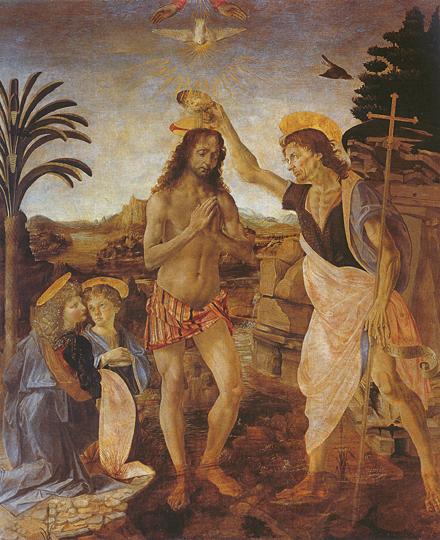
The sinless Son of God, who has no need to be baptized, submits to a sinner’s baptism. The Light of God, in whom is no darkness at all, goes into the depths of the River Jordan, buried before His death. The pure Word of God, who came to proclaim the truth, stands mute before the Voice which prepared His way.

A divine whisper proclaims the Beloved as the Father’s own. Fluttering wings form a nimbus. And with the Baptism of our Lord all water becomes holy. The water created by God at the beginning; the water through which the ark safely traveled; the water through which the Israelites marched dry-shod -- all is made holy. The water which flowed over the Word Made Flesh has gone on to mingle with all the water of the whole earth, and by that water we are made clean.

Heavenly Father, whose blessed Son Jesus Christ did take our nature upon him, and was baptised for our sakes in the river Jordan: mercifully grant that we, being regenerate and made thy children by adoption and grace, may also be partakers of thy Holy Spirit; through the same Jesus Christ thy Son our Lord, who liveth and reigneth with thee, in the unity of the Holy Spirit, ever one God, world without end. Amen.

08 January 2015

Manifestation of the God-Man

We sometimes forget that the Epiphany involves more than the visit from the Wise Men.  The Church has always linked three events - the visit of the Magi, the Baptism of Our Lord, and Christ's first miracle at the wedding in Cana - and together these are the Epiphany: the manifestation of the God-Man to the world.


Almighty God, whose Son our Savior Jesus Christ is the light of the world: Grant that thy people, illumined by thy Word and Sacraments, may shine with the radiance of Christ’s glory, that he may be known, worshiped, and obeyed to the ends of the earth; through the same Jesus Christ our Lord, who with thee and the Holy Spirit liveth and reigneth, one God, now and for ever. Amen.

06 January 2015

St. Raymond of Peñafort


St. Raymond of Peñafort lived to be a hundred years old, and with such a long life, he had the opportunity to do lots of things, and he certainly took full advantage of all the time God gave him on this earth. St. Raymond was born into a Spanish family of noblemen, which meant that he had the resources and the education to get a very good start in life.

By the time he was 20, St. Raymond was teaching philosophy. In his early 30s he earned a doctorate in both canon law and civil law. When he was 41 he became a Dominican. Pope Gregory IX called him to Rome to work for him and to be his confessor. One of the things the pope asked him to do was to gather together all the decrees of popes and councils. St. Raymond compiled five books called the Decretals, and this was really the beginning of an organized system of canon law for the Church. In fact, since St. Raymond’s work, the first actual Code of Canon Law was put together in 1917.

St. Raymond wrote a book for confessors which was a collection of various situations and sins, and in this book he discussed the different doctrines and laws of the church which would be applied in the various cases – a work which was very helpful to confessors.

At the age of 60, St. Raymond was appointed archbishop of Tarragona, the capital of Aragon. He didn't like the honor at all and ended up getting sick and resigning in two years.

He didn't get to enjoy his peace for long, however, because when he was 63 he was elected by his fellow Dominicans to be the head of the whole Order, the successor of St. Dominic. St. Raymond worked hard, visited on foot all the Dominican houses, reorganized their constitutions and managed to put through a provision that a master general be allowed to resign. When the new constitutions were accepted, St. Raymond, then 65, resigned as the head of the Dominicans. He still had 35 years ahead of him, and he spent those years very productively, opposing heresies and working for the conversion of the Muslims who were occupying Spain.

St. Raymond was a lawyer, especially a canon lawyer, and we might think that’s kind of a boring and dry job, but it is the law which outlines matters of justice and provides for the protection of the rights of individuals. Imagine the chaos if we had no laws in society. The same is true in the Church. Laws state ideally those things that are for the best interests of everyone and make sure the rights of all are safeguarded. From St. Raymond, we can learn a respect for law as a means of serving the common good.
O God, who didst appoint blessed Raymond excellently to minister the Sacrament of Penance, and didst wondrously make for him a passage upon the waves of the sea: grant, we pray thee; that, at his intercession, we may bring forth fruits worthy of repentance, and be found meet to attain to the harbour of everlasting salvation; through Jesus Christ thy Son our Lord, who liveth and reigneth with thee, in the unity of the Holy Spirit, ever one God, world without end. Amen.

05 January 2015

St. André Bessette

Brother André, whose baptismal name was Alfred, was born into a poor working family in 1845 in Canada, and both his parents had died by the time he was twelve. He was adopted by his aunt and uncle, but when he was fourteen they had moved to California to seek their fortune in the gold rush, leaving him to fend for himself. Young Alfred was sickly, and his bad health made it difficult for him to keep a job for very long, so he wandered from farm to farm and town to town in Canada and also in the United States, picking up odd jobs as he went. Finally he came to the Holy Cross Brothers in 1870. He carried with him a note from his pastor saying, "I am sending you a saint." The Brothers found that difficult to believe. The Holy Cross Brothers were teachers and, at 25, Alfred still did not know how to read and write. Alfred had no place else to go and so was in a desperate situation, but he was also prayerful and deeply devoted to God and Saint Joseph. He may have had no place left to go, but he believed that was because this was the place where he should have been all along.

The Holy Cross Brothers took him into the novitiate but soon found out what others had learned – as hard as Alfred (now Brother André) wanted to work, he simply wasn't strong enough. They asked him to leave the order, but André, out of desperation again, appealed to a visiting bishop who promised him that André would stay and take his vows as a Religious Brother.

After his vows, Brother André was sent to Notre Dame College in Montreal (a school for boys age seven to twelve) as a porter. There his responsibilities were to answer the door, to welcome guests, find the people they were visiting, wake up those in the school, and deliver mail.

In 1904, he surprised the Archbishop of Montreal by requesting permission to build a chapel to Saint Joseph on the mountain near the college. The Archbishop refused to go into debt and would only give permission for Brother André to build what he had money for. What money did Brother André have? Only the nickels he had collected as donations for Saint Joseph from haircuts he gave the boys; nickels and dimes from a small dish he had kept in a picnic shelter on top of the mountain near a statue of St. Joseph with a sign "Donations for St. Joseph." He had collected this loose change for years but he still had only a few hundred dollars. Who would start a chapel now with so little funding?

André took his few hundred dollars and built what he could – a small wood shelter only fifteen feet by eighteen feet. He kept collecting money and went back three years later to request to do more building. The Archbishop granted him permission to keep building as long as he didn't go into debt. He started by adding a roof so that all the people who were coming to hear Mass at the shrine wouldn't have to stand out in the rain and the wind. Then came walls, heating, a paved road up the mountain, a shelter for pilgrims, and finally a place where Brother André and others could live full-time to take care of the shrine and the pilgrims who came.. Through kindness, caring, and devotion, Brother André helped many souls experience healing and renewal on the mountaintop. There were even cases of physical healing. But for everything, Brother André thanked St. Joseph.

Despite financial troubles, Brother André never lost faith or devotion. He had started to build a basilica on the mountain but the Depression had interfered. When he was ninety years old he told his co-workers to place a statue of St. Joseph in the unfinished, unroofed basilica. He was so ill he had to be carried up the mountain to see the statue in its new home. Brother André died soon after on January 6, and didn't live to see the work on the basilica completed. But he died in peace, having helped hundreds of thousands of people by strengthening their faith, and by giving honor to the foster-father of our Lord.

O Lord our God, who art friend of the lowly and who gavest to thy servant, Saint André Bessette, a great devotion to Saint Joseph and a special commitment to the poor and afflicted: help us through his intercession to follow his example of prayer and love, and so come to share with him in thy glory; through Jesus Christ thy Son our Lord, who liveth and reigneth with thee, in the unity of the Holy Spirit, ever one God, world without end. Amen.

The Sermon for Epiphany


If there is no image, you may access the video through this link.

04 January 2015

St. John Neumann


This American saint was born in Bohemia, which today is within the Czech Republic, in 1811. He completed his seminary formation, and was looking forward to being ordained in 1835, when his bishop decided there would be no more ordinations. It is difficult for us to imagine now, but Bohemia had more priests than they needed. John wrote to bishops all over Europe but the story was the same everywhere: no one wanted any more priests. He was sure he was called to be a priest but all the doors to follow that vocation seemed to close in his face.

But John didn't give up. He had learned English by working in a factory with English-speaking workers, so he wrote to the bishops in America. Finally, the bishop in New York agreed to ordain him. So John left his homeland, and sailed to America, knowing he would probably never return to his home again.

In New York, Fr John Neumann was one of 36 priests for 200,000 Catholics. His parish in western New York stretched from Lake Ontario to Pennsylvania. He spent most of his time traveling from village to village, climbing mountains to visit the sick, staying with different families, or in taverns and inns along the way, finding places to teach the Faith, and celebrating the Mass at kitchen tables.

Because of the work and the isolation of his parish, the young priest felt the need to be part of a community, and so he joined the Redemptorists, a congregation of priests and brothers dedicated to helping the poor and most abandoned.

Fr John Neumann was appointed bishop of Philadelphia in 1852. As bishop, he was the first to organize a diocesan Catholic school system. Sharing same vision as St. Elizabeth Ann Seton, St. John Neumann was a founder of Catholic education in this country, and he increased the number of Catholic schools in his diocese from two to 100.

He had a great ability to learn languages, and he was able to learn Spanish, French, Italian, and Dutch, so that he could hear confessions in at least six languages. When Irish immigration started, he learned Gaelic so well that one Irish woman remarked, "Isn't it grand that we have an Irish bishop!"

He spent all his energy on being a great bishop to his people, and he lived very simply. He was only forty-eight years old when he died. He is buried in Philadelphia, in St. Peter’s Church, where pilgrims venerate his tomb and ask for his prayers.

O God, who didst call the Bishop Saint John Neumann, renowned for his charity and pastoral service, to shepherd thy people in America: grant, by his intercession; that, as we foster the Christian education of youth and are strengthened by the witness of brotherly love, we may constantly increase the family of thy Church; through Jesus Christ thy Son our Lord, who liveth and reigneth with thee, in the unity of the Holy Spirit, ever one God, world without end. Amen.

"Rejoice for your glorious daughter..."

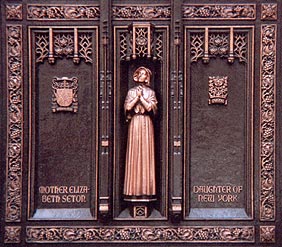
These were the words of Pope Paul VI when he preached at the canonization of St. Elizabeth Ann Seton: "She is a saint!... Rejoice for your glorious daughter." Born in 1774, just as our nation was stirring in preparation for its own birth, little would indicate that some two hundred years later this delicate infant, born in wealth and raised in the society of the established elite, would be raised to the honor of the altar by the Vicar of Christ on the site of the martyrdom of St. Peter.

"Elizabeth Ann Bayley Seton is a Saint! She is the first daughter of the United States of America to be glorified with this incomparable attribute!" The Pope spoke with unexpected emotion and excitement, so remarkable was the revelation that a woman who should have remained anonymous and safe within the fold of her respectable family, had embarked upon the spiritual journey for truth which she knew could lead only to one unfashionable destination: the Catholic Church.

The Holy Father took care to remind the world that the religious sensibility, the spiritual goodness of the saint, was planted and nurtured in Anglicanism. "We willingly recognize this merit, and, knowing well how much it cost Elizabeth to pass over to the Catholic Church, we admire her courage for adhering to the religious truth and divine reality which were manifested to her therein," the Pope said.

The young widow could have remained in her Trinity Church pew, gazing out the window toward St. Peter's Church on Barclay Street. Everything and everyone around her should have caused hesitation, but her heart had gone before, because the Divine Heart was waiting for her there. As another great convert would later say, "Cor ad cor loquitur."

O Lord God, who didst bless St. Elizabeth Ann Seton with singular gifts of grace as wife and mother, educator and foundress, that she might spend her life in service to thy people: Grant we beseech thee, that through her example and intercession we may learn to express our love for thee in love for our fellow man; through Jesus Christ our Lord, who liveth and reigneth with thee and the Holy Spirit, one God, for ever and ever. Amen.

+ + + + +

A brief biography, from various sources:

St. Elizabeth Ann Seton, known as Mother Seton, is one of the great saints of our nation. Her accomplishments were amazing. Although she was a widow with five young children, she founded the first American religious community for women, the Sisters of Charity, and she opened the first American parish school and established the first American Catholic orphanage. She accomplished all this, even though she lived to be only 46 years old.

Elizabeth Ann Bayley Seton was a true daughter of the American Revolution. She was born in 1774, just two years before the Declaration of Independence. By birth and through her marriage, she was part the most prominent and wealthy families of New York. She was raised as an Episcopalian by her mother and stepmother, and through her religion, she learned the value of prayer, Scripture and a nightly examination of conscience.

Her mother died in when St. Elizabeth was not quite four years old, and her baby sister died that next year. Losing these people who were so important to her gave Elizabeth an understanding that life in this world is temporary, and she knew that it was important to accomplish as much as possible every day. She developed a sense of hope, and she made the effort to face everything with cheerfulness.

When she was 19, Elizabeth was the one of the most beautiful and wealthiest young women in all of New York. She married a handsome, successful businessman, William Seton. They had five children and were very happy. However, their fortunes changed -- his business failed, and eventually he died of tuberculosis. At the young age of 30, Elizabeth was widowed, she had no money left, and she had five small children to support.

She and her husband had traveled to Italy when he was very sick, hoping that he would get better in that warmer climate. That wasn’t to be, and as her husband was dying, Elizabeth witnessed the Catholic faith in action through family friends. Three basic points led her to become a Catholic: belief in the Real Presence, devotion to the Blessed Mother and conviction that the Catholic Church led back to the apostles and to Christ. She herself decided to enter the Catholic Church in 1805, and when she did that, most of her family and friends never spoke to her again.

In order to support her children, Elizabeth opened a school in Baltimore. From the beginning, she and her teachers followed the pattern of a religious community, and it was formally founded as the Sisters of Charity in 1809.

We have more than a thousand letters written by Mother Seton, and they reveal the development of her spiritual life from ordinary goodness to heroic sanctity. She suffered great trials of sickness, misunderstanding, the death of loved ones (her husband and two young daughters) and the heartache of a wayward son. She died January 4, 1821, and became the first American-born citizen to be beatified (1963) and then canonized (1975). She is buried in Emmitsburg, Maryland.

Elizabeth Seton had no extraordinary gifts. She was not a mystic or stigmatic. She did not prophesy or speak in tongues. She had two great devotions: abandonment to the will of God and an ardent love for the Blessed Sacrament.

03 January 2015

The Epiphany of Our Lord

"Star of Bethlehem" by Burne-Jones

Epiphany is about light. "Arise, shine; for your light has come, and the glory of the Lord has risen upon you." It is about the coming of the true Light into the darkness of this world. "Jesus Christ is the Light of the world, the Light no darkness can overcome." "In Him was life, and that life was the light of men."

The chief image of Epiphany is the star in the East whose light guided the Magi to the Child-King enthroned on His mother's lap. The Light of God's love had come to shine on the Gentiles, too. "The people walking in darkness have seen a great light; those who dwelt in a land of deep darkness, on them has light shined." The Gentiles worship Him with gifts fit for a king: gold, frankincense, and myrrh. The Magi rejoice in the light, and bow down and worship Him.

Light was the first word spoken by God into the chaotic darkness of creation. "Let there be light." And there was light. “God is light, and in Him there is no darkness."

Our lives are given to reflect the light of God's glory, and this is the noblest and most blessed purpose of all. We are, in a mystical way, to be an “epiphany” of Christ, so that every man can see His glory, and so welcome His Light into the dark world.

O God, who by the leading of a star didst manifest thy only-begotten Son to the peoples of the earth: Lead us, who know thee now by faith, to thy presence, where we may behold thy glory face to face; through the same Jesus Christ our Lord, who liveth and reigneth with thee and the Holy Spirit, one God, now and for ever. Amen.

Jesus Christ, our Saviour King,
unto thee thy people sing;
hear the prayers we humbly make,
hear them for thy mercy’s sake.
Lord Jesus Christ, O Lamb Divine,
fill our souls, and make us thine.

Give us eyes that we may see;
give us hearts to worship thee;
give us ears that we may hear;
in thy love, Lord, draw us near.
Lord Jesus Christ, O Lamb Divine,
fill our souls and make us thine.

In our darkness, shed thy light;
lift us to thy heav’nly height;
may we be thy dwelling-place,
tabernacles of thy grace.
Lord Jesus Christ, O Lamb Divine,
fill our souls and make us thine.

In thy Kingdom grant us rest,
in Jerusalem the blest;
with the saints our lips shall sing,
with the angels echoing:
Lord Jesus Christ, O Lamb Divine,
thou dost reign, and we are thine!

Text: Fr. Christopher G. Phillips (1990)
Music: “Lucerna Laudoniae”
David Evans (1874-1948)

02 January 2015

The Most Holy Name of Jesus


One of the customs we maintain at the parish is that of bowing one's head at the name of our Lord. It's nothing exaggerated, but just a sign of respect at the sound of the Name of our salvation. There are so many acts of courtesy and respect which have been lost in our everyday living, but there are things such as this that I refuse to put aside. It may seem a little thing, but I believe it is important that we pause and acknowledge the wonder of what God in Christ has done, and is doing. The very idea that the Creator of all things has such love for us that He has put on human flesh in the womb of the chosen maiden, and has taken for Himself the particular name of Jesus, and gives Himself to us daily in the Holy Sacrifice of the Mass -- that should make us want to bow our heads in wonder and praise. "For there is no other name under heaven given to men, whereby we must be saved."

Almighty God, who by thy blessed Apostle hast taught us that there is none other name given among men whereby we must be saved, but only the Name of our Lord Jesus Christ: grant, we beseech thee; that we may ever glory in this Name, and strive to make thy salvation known unto all mankind; through the same Jesus Christ thy Son our Lord, who liveth and reigneth with thee, in the unity of the Holy Spirit, ever one God, world without end. Amen.
*  *  *  *  *

Litany of the Holy Name of Jesus

V. Lord, have mercy on us.
R. Christ, have mercy on us.
V. Lord, have mercy on us. Jesus, hear us.
R. Jesus, graciously hear us.
V. God the Father of Heaven
R. Have mercy on us.
V. God the Son, Redeemer of the world,
R. Have mercy on us.
V. God the Holy Spirit,
R. Have mercy on us.
V. Holy Trinity, one God,
R. Have mercy on us.
V. Jesus, Son of the living God, R. Have mercy on us.
Jesus, splendor of the Father, [etc.]
Jesus, brightness of eternal light.
Jesus, King of glory.
Jesus, sun of justice.
Jesus, Son of the Virgin Mary.
Jesus, most amiable.
Jesus, most admirable.
Jesus, the mighty God.
Jesus, Father of the world to come.
Jesus, angel of great counsel.
Jesus, most powerful.
Jesus, most patient.
Jesus, most obedient.
Jesus, meek and humble of heart.
Jesus, lover of chastity.
Jesus, lover of us.
Jesus, God of peace.
Jesus, author of life.
Jesus, example of virtues.
Jesus, zealous lover of souls.
Jesus, our God.
Jesus, our refuge.
Jesus, father of the poor.
Jesus, treasure of the faithful.
Jesus, good Shepherd.
Jesus, true light.
Jesus, eternal wisdom.
Jesus, infinite goodness.
Jesus, our way and our life.
Jesus, joy of Angels.
Jesus, King of the Patriarchs.
Jesus, Master of the Apostles.
Jesus, teacher of the Evangelists.
Jesus, strength of Martyrs.
Jesus, light of Confessors.
Jesus, purity of Virgins.
Jesus, crown of Saints.

V. Be merciful, R. spare us, O Jesus.
V. Be merciful, R. graciously hear us, O Jesus.
V. From all evil, R. deliver us, O Jesus.
From all sin, deliver us, O Jesus.
From Your wrath, [etc.]
From the snares of the devil.
From the spirit of fornication.
From everlasting death.
From the neglect of Your inspirations.
By the mystery of Your holy Incarnation.
By Your Nativity.
By Your Infancy.
By Your most divine Life.
By Your labors.
By Your agony and passion.
By Your cross and dereliction.
By Your sufferings.
By Your death and burial.
By Your Resurrection.
By Your Ascension.
By Your institution of the most Holy Eucharist.
By Your joys.
By Your glory.

V. Lamb of God, who takest away the sins of the world,
R. spare us, O Jesus.
V. Lamb of God, who takest away the sins of the world,
R. graciously hear us, O Jesus.
V. Lamb of God, who takest away the sins of the world,
R. have mercy on us, O Jesus.

V. Jesus, hear us.
R. Jesus, graciously hear us.

Let us pray.

O Lord Jesus Christ, You have said, "Ask and you shall receive, seek, and you shall find, knock, and it shall be opened to you." Grant, we beg of You, to us who ask it, the gift of Your most divine love, that we may ever love You with our whole heart, in word and deed, and never cease praising You. Give us, O Lord, as much a lasting fear as a lasting love of Your Holy Name, for You, who live and are King for ever and ever, never fail to govern those whom You have solidly established in Your love. R. Amen.